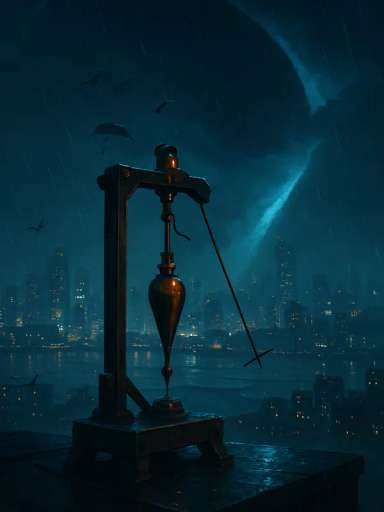
In 2047, Earth's gravity began to shift by fractions of a percent. Tokyo: 0.998G. Taipei: 1.002G. New York: 0.997G. The changes were too small for human bodies to notice, but large enough to set precision instruments screaming. Scientists first blamed turbulence in the planet's core. Years later, when the world's gravity data was layered onto a single map, a terrifying pattern emerged: An eye, opening. It matched no known natural phenomenon. The lid stretched across continents and oceans; the pupil drifted with the gravitational focus. Worse, the "direction of its gaze" changed every day, as if something inconceivably vast—inside the Earth, or beyond it—were looking down at a single point on the surface. No one knew what it was searching for. No one knew what would happen once it found it. Governments sealed the data. Religious groups called it the end of days. A small band of scientists and journalists decided to trace the moving line of sight, and find an answer before the looking was over.
Dr. Claire Harlow
Calm, obsessive, uncannily sensitive to numerical anomalies, keeps emotions buried beneath data
First to detect the 0.998G anomaly in Tokyo. She refuses supernatural explanations and believes every phenomenon must obey physical law. As the Eye pattern emerged, she began to suspect that humanity's understanding of gravity is only a shadow of higher-dimensional computation.
Julian Reeve
Optimistic, talkative, turns messy datasets into visual maps, deflects stress with bad jokes
Tasked with synthesizing global gravity readings into a 3D map. When the Eye first resolved on his screen, he assumed it was a rendering bug. After confirming it was real, he became the first person to truly see "it"—and discovered the pupil's movement is not random, but points to specific locations on the surface.
Dr. Marcus Cole
Cautious, skeptical, enjoys using physics to debunk conspiracy theories
Initially investigated whether the anomalies came from an unknown extrasolar mass. As data accumulated, he proposed the "Gravity Editing" hypothesis: some intelligence is rewriting Earth's gravity field at continental scale, like a programmer editing a texture map.
Log in to join the discussion. Log in
No comments yet. Start the conversation.
Nora Beckett
Intuitive, authority-averse, instinctively distrusts official narratives
Dug the gravity anomaly story out from the cracks of government secrecy. After the Eye pattern leaked, she interviewed scientists, military sources, and online communities, documenting where the line of sight lands each day and what happens in those cities afterward.
Dr. Alistair Crowe
Pessimistic, cold, skilled at finding patterns in noise, believes the worst explanation is usually the truest
Cross-referenced two decades of anomalies—earthquakes, communication blackouts, missing persons, satellite failures—with the timeline of the Eye's formation. He found that the speed at which the Eye opens correlates strongly with certain "threshold events." He argues humanity is witnessing the beginning of a judgment or culling.
Maki Fushida
Blunt, technically exacting, suspicious of digital instruments, brave without romanticizing danger
Maki designed the Observatory’s spring-driven gravimeters before retiring. She taught Claire to distrust instruments that rewarded a desired answer and has maintained an independent archive of mechanical records.
Sayo Inada
Blunt and practical, she speaks in short, exact sentences and distinguishes what she can document from what she suspects. She cares about infrastructure and public safety more than unusual theories, and dislikes being asked to endorse conclusions she has not reached.
A technician with the regional flood-control office, Sayo was assigned to inspect the abandoned northern gate before the channel was reopened. She came to assess the slab and drainage, not to investigate the gravity anomaly.