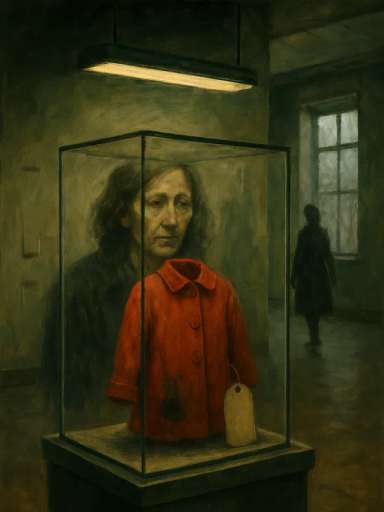
Mara, a museum curator nearing fifty, works at a local museum in the American Midwest that is scheduled to close. She is responsible for cataloguing a collection of personal belongings donated by local residents: a pair of dance shoes, a box of undeveloped film, a key whose owner has been missing for many years, and a child’s coat stained with blood. Each object carries a story of grief that was never recorded in history. As Mara organizes other people’s memories, she gradually discovers that several of the objects are connected to her younger sister, from whom she became estranged many years ago.
Mara Ellison
Observant, restrained, meticulous, empathetic, emotionally avoidant
Mara is a curator nearing fifty who has spent most of her adult life preserving other people’s memories while keeping her own carefully sealed away. She works at the Bellwether County Museum, a small local institution in the American Midwest that is preparing to close. Mara is highly perceptive and instinctively notices the emotional significance of ordinary objects, but she struggles to speak honestly about her own grief. When several donated items appear to be connected to her estranged younge
Elena Ellison
Restless, imaginative, fiercely independent, impulsive, emotionally intense
Elena was Mara’s younger sister and the more adventurous of the two. As a teenager, she dreamed of becoming a photographer and often disappeared for days at a time, chasing stories, strangers, and places beyond their small Midwestern town. The sisters became estranged after a painful family conflict, after which Elena vanished from Mara’s life. Although Elena never appears directly in the museum’s records, traces of her begin to surface in the donated objects, forcing Mara to reconsider what she
Thomas Reed
Practical, warm, quietly anxious, diplomatic, conflict-averse
Thomas has directed the museum for nearly twenty years and knows almost everyone in the county. He believes the museum’s closure is inevitable, but he is determined to preserve its dignity and make sure the collection is not scattered without care. Thomas relies heavily on Mara’s judgment and sees her as the museum’s moral center. He senses that the donated objects are affecting her personally, but he respects her privacy—perhaps more than he should.
Log in to join the discussion. Log in
No comments yet. Start the conversation.
June Whitaker
Witty, skeptical, fiercely loyal, curious, direct
June is a younger archivist who specializes in local newspapers, family records, and forgotten community histories. Unlike Mara, she has little patience for romanticizing the past. She believes that archives are full of omissions, distortions, and deliberate lies. June becomes the first person to notice inconsistencies in the records connected to Elena and encourages Mara to investigate them. Her friendship with Mara is affectionate but complicated, as June worries that Mara is becoming more inv
Walter Mercer
Reserved, formal, guilt-ridden, deeply sentimental
Walt is a retired school custodian who donates a child’s coat that has remained in his attic for more than thirty years. He claims that the coat belonged to a neighbor’s child, but his account changes each time Mara asks about it. Walt is respected in the community as a decent and dependable man, yet he carries a private shame connected to an accident that was never publicly discussed. His donation becomes one of the museum’s most disturbing and emotionally charged objects.
Iris Bell
Elegant, proud, sharp-tongued, nostalgic, emotionally guarded
Iris was once the most gifted dancer in the county and donated a pair of worn dance shoes after moving into assisted living. She remembers the past in vivid fragments but refuses to explain why she stopped dancing at the height of her promise. Iris knew Elena during her teenage years and may have been one of the last people to see her before she left town. Her memories offer Mara a version of Elena that is both tender and unsettling.
Samuel Ortiz
Patient, introverted, perceptive, quietly humorous
Samuel worked as a freelance photographer for the local newspaper before leaving journalism. He donates a box of undeveloped film that he found among the belongings of a deceased colleague. The film contains images from a summer that Mara remembers only vaguely, including several photographs in which Elena may appear. Samuel does not trust memory, but he believes photographs can reveal what people tried not to see.
Noah Ellison
Gentle, pragmatic, emotionally open, occasionally impatient
Noah is Mara’s only child and works as a high school teacher in a nearby town. He has grown accustomed to his mother’s silences and understands that Elena’s absence shaped Mara’s entire life, even though she rarely speaks about it. Noah wants Mara to leave the museum and begin a new chapter, but he gradually realizes that the museum may be the only place where she can finally confront the truth. His relationship with Mara reflects the novel’s central question: whether preserving the past can hel
Daniel Mercer
Absent from the present record; remembered through the vulnerability of childhood and the adults’ secrecy
Daniel was eight years old in 1989 when he fell through a damaged maintenance cover at the old pump house. He survived the injury, but the adults around him altered the official account of what happened.
Raymond Mercer
Absent from the present record; implicated through Walter’s guarded account
Raymond was responsible for Daniel’s care at the pump house during the accident and allegedly stood over the child afterward. His role in concealing the incident remains unclear.
Ruth Kessler
Practical, observant, guarded but compassionate, with an archivist’s memory for tenants
Ruth managed the Fremont Avenue building for more than three decades and kept old tenant records and abandoned belongings rather than allowing them to vanish.
Teresa “Tess” Venn
Wary, observant, resourceful, shaped by distrust but capable of fierce attachment
Teresa was fifteen or sixteen in 1995 when Elena sheltered her in the Minneapolis apartment. She had witnessed the pump-house incident and later disappeared from the surviving local records.
Cal Mercer
Charming in photographs, elusive, and apparently controlling beneath his ease
Cal lived with or near Elena during her Minneapolis years and knew about Tess. Elena’s notes suggest he located them before they were ready to be found.
Celia Arnaud
Blunt, practical, protective of abandoned people and their belongings
Celia rented rooms in the demolished Rutger Street boardinghouse and allowed Miriam Kline to stay unofficially. She preserved old leases, mailbox doors, and personal effects after tenants vanished.
Miriam Kline
Resourceful, self-effacing, compassionate, wary of men who use official stories to control others
Miriam sheltered Elena in the rear room of her St. Louis boardinghouse in 1995 and helped her hide evidence after Cal and Raymond began looking for them. She later disappeared west and eventually returned to the St. Louis area, where she died without family listed in her obituary.
Etta Rusk
Weathered, discreet, practical, protective of abandoned people and the promises made to them
Etta ran Harbor House as a quiet lodging place for women who needed somewhere to stay without explaining themselves. She preserved its rooms and informal guest records long after the house stopped operating as a boardinghouse.
Lenora Pike
Practical, exacting, institution-minded, and more receptive to ethical argument than she first appears
Lenora manages the county archive’s transfers and finding aids, balancing limited staff and legal obligations against the danger of reducing complicated collections to convenient summaries.
Cora Bell
Lonely, proud, patient, and resigned to an abandonment she never received an explanation for
Cora lived in Harbor House for six months while waiting for a daughter who never came for her. Elena photographed her room and listened to her story during Elena’s stay.