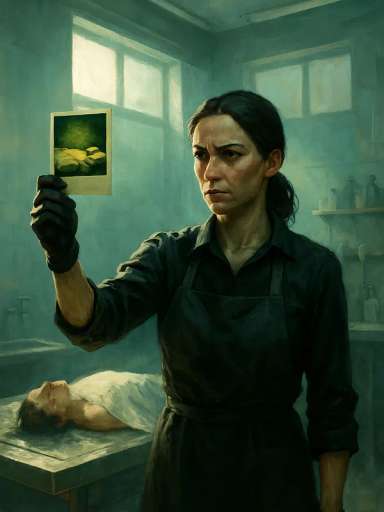
A mortician discovers a photograph in her Polaroid camera that shows her own dead body. The date printed on the photo is seven days in the future. The next day, another photograph appears. Then another. Each one shows a different way she could die. She has seven days to find out who—or what—is taking the photographs before the final picture develops.
Iris Calloway
Precise and dry-humored; unflappable around the dead but avoidant around the living. Wants every mystery to have a rational cause; treats grief — especially her own — as a problem to manage, not feel.
Thirty-seven, she runs Calloway & Sons, the funeral home her late father built and she inherited a year ago. While clearing his study she found his old Polaroid SX-70 — and the next morning it held a photo of her own body laid out on her embalming table, dated seven days from now.
Tomás Reyes
Gentle, watchful, quietly superstitious beneath professional calm. Wants to believe his photographs honor the dead rather than feed on them; still carries guilt over a scene he photographed years ago.
He has photographed the county's dead for a decade and calls on Iris whenever a body needs the funeral home. She trusts his eye — he is the first person she shows the Polaroid to, partly to prove it must be fake, partly because he is the only one who understands what it means to look at death through a lens.
Ruth Ellery
Blunt, procedural, protective in a way that feels like impatience. Wants to keep Iris safe but only trusts what fits in an incident report; her flaw is dismissing what she cannot file.
She signed off on the elder Calloway's death a year ago — a heart attack, open and shut, though she remembers small things about that night she never wrote down. When the second photo appears, Iris goes to her; Ruth agrees to look into it as a stalking case, which is the only frame she knows how to build.
Log in to join the discussion. Log in
No comments yet. Start the conversation.
The Witness-Form
Impersonal, persistent, and imitative; it follows the logic of a death record rather than human motive.
When Edwin Calloway interrupted the death prepared for him, the witness-role did not disappear. It continued as a faceless figure wearing aspects of Edwin, carrying a Polaroid camera, and seeking to complete the interrupted record.
Agnes Vale
Controlled, procedural, patient, and quietly afraid of contradictions she cannot file or contain.
Agnes has maintained the corridor of death records for years, preserving photographs and witnessing the decisions that make them permanent. She knew Edwin Calloway and understood the system's keeping function, but never fully revealed herself to him.
The elder Calloway
Worn and guarded, he speaks in short, practical statements and leaves out what he fears will make the listener act before he can explain himself.
He staged his death and remained tied to the archive’s unfinished record; he is identified by a scarred index knuckle and a chipped wedding ring.